Gentlemen
It is a short 11-minute stroll from the lakefront to Boystown; from the Kwa-Ma-Rolas totem pole to the Black Hawk War, it was a span of 97 years.
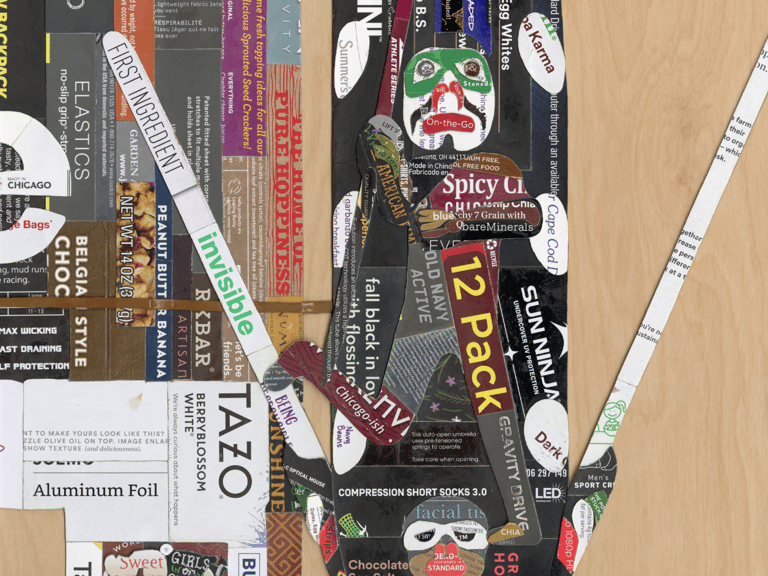
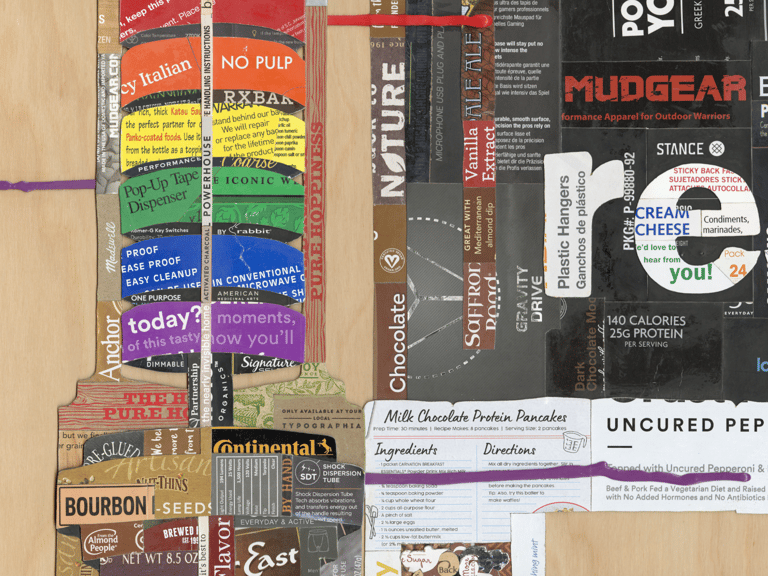
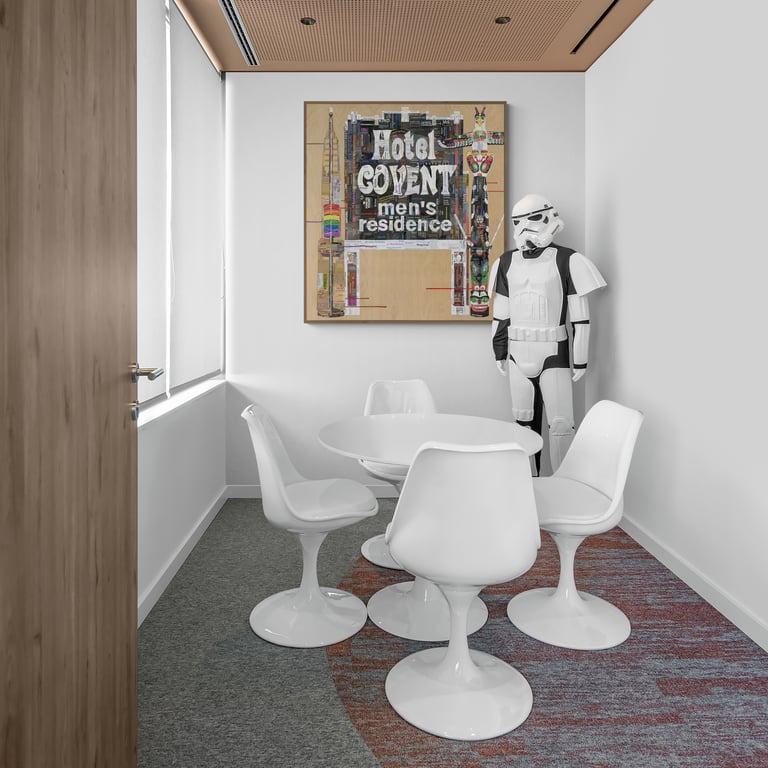
The Gentlemen piece is a composition of symbolic imagery from three historic landmarks in Chicago’s Lakeview and Lincoln Park neighborhoods.
On the right-hand side there is a depiction of the Kwa-Ma-Rolas totem pole, also known as Kwanusila or the Thunderbird, a symbol of strength and protection. It is a 40-foot-tall monument carved out of red cedar, a faithful replica of a Northwest Coast totem pole gifted to the Chicago Park District in 1929.
On the left there is a Rainbow Pylon, an icon of the Legacy Walk on Halsted Street. In 1997, Boystown, the community area along North Halsted Street in Lakeview, became the first officially recognized LGBTQ+ village in the United States.
The center of the composition articulates the painted sign and building façade of the historic Covent Hotel in Lincoln Park. The working-class rooming hotel was built in 1915 to serve the influx of transient male laborers who came to Chicago for industrial jobs.
The History of the Kwa-Ma-Rolas, the Totem Pole at Addison Street and Lake Shore Drive:
Among the Jackson Park exhibits at the Chicago World’s Fair in 1893 was the American Indian Village, created by George Hunt, on a commission from Harvard Anthropology and the Peabody Museum. Totem poles depicting the native Thunderbird figure were historically made for chiefs and wealthy members of the tribe. They represent strength and provide a spiritual defense against floods and droughts. The objects from the exhibit were donated to the Field Museum after the exposition.
Drawn to the Northwest Coast Indian culture, James Kraft, founder of Kraft Foods, set out for Alaska and the Pacific Northwest. On his trip in 1926, he purchased two totem poles and shipped them to Chicago by rail from British Columbia. One of the poles was placed on Kraft’s private property in Wisconsin. In 1929, Kraft gifted the second pole to the City of Chicago. It was installed in Lincoln Park, at Adisson Street and Lake Shore Drive, and was dedicated to the schoolchildren of Chicago.
The 40-foot totem pole is carved from a single log of Western red cedar. Kwanusila, the Thunderbird figure, appears at the top of the totem pole with its wings stretched out. The Thunderbird would only preserve its protective powers when positioned that way, according to traditional belief. Around the base of the pole there is a sea monster. The sea monster represents a window into the unknown and supernatural beings from oral history. The main body of the pole is shaped like a whale with its tail in the air and has a human figure in the center. The killer whale is a symbol of longevity and community. It is believed that killer whales can communicate with humans, and that humans can be transformed into killer whales.
Research conducted by the Field Museum in 1982 brought into focus the historical and cultural significance of the lakefront totem pole. Following a visit to Chicago by the Kwakiutl Indians of Vancouver Island, the Canadian government requested the repatriation of the pole. In turn, the Chicago Park District donated the original Kwa-Ma-Rolas to the museum at the University of British Columbia in 1985.
While the original artifact was in Vancouver Island for evaluation, Kraft Foods commissioned artist Tony Hunt to carve a replica of the totem pole. Tony Hunt is a descendent of George Hunt, who created the Native village display at the Columbian Exposition in Chicago in 1893. The new totem pole was officially dedicated in 1986. It is an exact copy of the original pole from 1929.
The Kwa-Ma-Rolas totem pole is located on the lakefront trail in Lincoln Park at 3510 North Recreation Drive, Chicago, Illinois.
The History of the Covent Hotel on Clark Street in Lincoln Park:
The Covent Hotel was a rooming hotel built in 1915, a type of residential hotel common in Chicago in the early 20th century. The hotel provided single-room occupancy housing (SRO) to working-class immigrants, mostly single men arriving in Chicago for transient jobs in steel mills, railroads, and meatpacking.
The building was designed by Frank E. Davidson in the neoclassical style, also referred to as Classical Revival architecture. It has blind arches and brick piers along the external walls, and a continuous parapet surrounding the entire perimeter of the roof. The three-story building was a mixed-use development. It housed 64 single rooms and had a commercial space on the first floor, including a restaurant. Adjacent to the hotel was a theater complex, The Covent Garden Theater, that featured stage shows and motion pictures. After the theater closed in 1958, the auditorium area was demolished and replaced by a parking lot.
In 2014, an initiative led by Mayor Rahm Emanuel to provide affordable housing opportunities to low-income households resulted in the enactment of the SRO Preservation Ordinance. The city regulation highlighted the essential role of existing SRO properties in sustaining the quality of life for Chicago’s residents. It outlined a path and financial opportunities for developers to invest in the preservation of SRO properties.
In 2016, the Covent Hotel building was sold to the NHP Foundation, a nonprofit real estate corporation specializing in affordable housing innovation through partnerships with government entities. The Covent Hotel building was added to the National Register of Historic Places in 2017. Soon after, planning began to convert the historic hotel into The Covent Apartments to create 30 modern studio units while maintaining the building’s cultural and architectural legacy.
Many of the old doors and windows were preserved in the rehab. There is a ghost sign relic on the top of the south wall that reads: “Hotel Covent / men’s residence.” The renovation project was completed in 2023.
The Covent Hotel building is located at 2653-65 North Clark Street, Chicago, Illinois.
About the Rainbow Pylons on Halsted Street in Boystown:
A series of 20 sculptural steel pylons designed in the style of an Art Deco skyscraper were installed in 1997 along a half-mile section of Halsted Street in Lakeview. They marked a shift in politics and the treatment of LGBTQ+ people in Chicago. It was the first streetscape in the United States that was officially dedicated to the LGBTQ+ community by a city government.
During the 1970s, many lesbian and gay bars began to migrate from downtown to Lincoln Park and Lakeview, and new LGBTQ+ residents and business owners permanently settled in the area. In 1988, the City of Chicago under Mayor Eugene Sawyer outlawed discrimination based on sexual orientation in employment and housing. In 1989, Mayor Richard M. Daley proposed the Halsted Street beautification project to recognize and legitimize the LGBTQ+ community. The street renovation was officially dedicated in 1998.
The Rainbow Pylons are distinctive works of art created by the architecture firm DeStefano + Partners. Each pylon is 25 feet tall, painted in a metallic bronze color with a lighted beacon on the pinnacle. In the middle of the pylon there is a stack of six metal rings painted in the six rainbow colors of the pride flag. The rainbow rings reference the “freedom rings,” a jewelry design from 1991 that became an icon of solidarity. The light symbolizes a beacon of hope for tolerance.
Beginning in 2012, bronze plaques have been mounted on the pylons by the Legacy Project to commemorate historical LGBTQ+ figures and their contributions. Together, the Rainbow Pylons and the bronze plaques constitute an outdoor museum, the Legacy Walk, that celebrates the achievements of LGBTQ+ people worldwide.
One of the plaques on the Legacy Walk is dedicated to the Two Spirit people, a notion from Native American culture that questions the definition of gender identity. In developing the composition for the Gentlemen piece, and in naming the artwork, I threaded the theme of gender roles across the three landmarks to express the shifts in societal norms.
My absolute favorite plaques are the plaques dedicated to Alan Turing and Leonardo, whose research studies and drawings have influenced my work and my artist statement.
I am intrigued by Leonardo’s persistent investigation of physics and by his geometry drawings. I admire his discipline in producing forms in an iterative, lengthy process of layering.
Alan Turing’s “imitation game,” aka Turing test, inspired my body of work involving poems constructed from random text snippets found on product packaging. Turing’s definition of artificial intelligence prompted my digital animation art pieces that reverse my work process: What if instead of generating a poem out of my painting, I let the machine generate the painting out of a poem, a sequence of text?
The Rainbow Pylons are located at 3247 through 3708 North Halsted Street, Chicago, Illinois.